

| "The views expressed by others are not necessarily shared by me personally but consistent with the paradigm we have entered, all views and perspectives are respected and hold equal weight" |
http://www.redorbit.
com/news/science/1789881/staggering_global_warming_statistics_emerge_as_un_meeting_looms/
Staggering Global Warming Statistics Emerge As UN Meeting Looms
Posted on: Monday, 23 November 2009, 06:20 CST
Since the 1997 international agreement to address global warming, climate change has
seen its ups and downs, including extremely bleak warnings.
So far, the world’s oceans have raised an inch and a half, serious droughts have
plagued parts of the world, temperatures everywhere are warmer, and several
endangered species continue to be threatened.
"The latest science is telling us we are in more trouble than we thought," said Janos
Pasztor, climate adviser to UN Secretary General Ban Ki-moon, to AP News.
It is suspected that since the original agreement signed in Kyoto, Japan, in December
1997, is that the amount of carbon dioxide in the air has grown 6.5%. Officials will meet
in Copenhagen next month to seek create a new pact, which President Barack Obama
says "has immediate operational effect ... an important step forward in the effort to rally
the world around a solution."
From 1997 to 2008, world carbon dioxide has leapt up 31%. Emissions from China
have doubled since 1997.
"Back in 1997, the impacts (of climate change) were underestimated; the rate of
change has been faster," noted Virginia Burkett, leading scientist for global change
research at the U.S. Geological Survey. This scares former Vice President Al Gore,
who helped create a last-minute pact in Kyoto.
"By far the most serious differences that we've had is an acceleration of the crisis
itself," Gore said to The Associated Press.
Since 1997, the issue of global warming has spread to all facets of business.
"We've come from a time in 1997 where this was some abstract problem working its
way around scientific circles to now when the problem is in everyone's face," said
Andrew Weaver, a University of Victoria climate scientist.
The issue that has scientists most afraid deals with the Arctic and melting summer sea
ice. Back in 1997 "nobody in their wildest expectations," would have contemplated a
loss of summer sea ice, Weaver said.
Globally, glaciers are disintegrating three times rapider than in the 1970s and the
normal glacier has melted 25 feet since 1997, mentioned Michael Zemp, scientist at
World Glacier Monitoring Service at the University of Zurich.
"Glaciers are a good climate indicator," Zemp said. "What we see is an accelerated
loss of ice."
Oceans are also growing more acidic due to carbon dioxide in the air that is being
drawn into the water. Acidic water is hazardous to coral, oysters and plankton and will
harm the ocean food chain, biologists note.
"The message on the science is that we know a lot more than we did in 1997 and it's all
negative," said Eileen Claussen, head of the Pew Center on Global Climate Change.
"Things are much worse than the models predicted."
Source: RedOrbit Staff & Wire Reports
====================
http://www.chron.com/disp/story.mpl/editorial/6734481.html
Hot times
As a crucial climate change conference nears, more evidence of a
warming globe
HOUSTON CHRONICLE
Nov. 22, 2009, 9:29PM
As world governments prepare for a pivotal conference in Copenhagen next month to
map future strategy to contain global warming, and the U.S. Congress debates
legislation to reduce carbon emissions, evidence continues to accumulate that the
threat is accelerating.
A new study by a team of British scientists indicates that man-made carbon emissions
continue to increase despite the global recession. While emissions in the United States
fell by 3 percent last year, they jumped 2 percent worldwide, most of the increase
coming from China. The U.S. and China are the world's largest carbon emitters.
Equally ominous, the planet's oceans are steadily losing capacity to absorb the
greenhouse gases that trap heat and fuel global warming.
The Global Carbon Project study concludes that unless emissions are substantially
reduced, the result would be a rise in average global temperature by nearly 10
degrees Fahrenheit by the end of the century. That is on par with previous worst-case
scenarios outlined by the United Nations Intergovernmental Panel on Climate Change.
Scientists have estimated that temperature spikes above 2 degrees could have
disastrous consequences, including large rises in sea level, droughts and stronger
storms.
One of the authors of the study, Professor Corinne Le Quere of the University of East
Anglia, says the conclusions raise the stakes for delegates to the Copenhagen
gathering, who will try to hammer out a successor to the Kyoto Accords that committed
signatory governments to emission reduction goals. The United States did not sign on
to that agreement.
In another indication that global warming is accelerating, record minimum sea ice in the
Arctic was reported last month. The Catlin Arctic Survey estimates that based on the
dwindling expanse and thickness of ice coverage, the Arctic Ocean will become ice free
in summer within two decades.
The latest developments should raise the political heat in Washington to produce
workable legislation to reduce carbon emissions while propelling the U.S. into a
leadership role in crafting an international agreement to limit climate change.
====================
Call For Independent Inquiry Into Climategate as Global Warming Fraud Implodes
http://www.prisonplanet.com/call-for-independent-inquiry-into-climategate-as-global-
warming-fraud-implodes.html
Paul Joseph Watson
Prison Planet.com
Monday, November 23, 2009
Calls for an independent inquiry into what is being dubbed “Climategate” are growing
as the foundation for man-made global warming implodes following the release of
emails which prove researchers colluded to manipulate data in order to “hide the
decline” in global temperatures.
Former British chancellor Lord Lawson was the latest to demand an impartial
investigation be launched into the scandal, which arrives just weeks before the UN
climate conference in Copenhagen. “They should set up a public inquiry under
someone who is totally respected and get to the truth,” he told the BBC Radio Four
Today programme.
The emails were leaked at the end of last week after hackers penetrated the servers of
the Climatic Research Unit, which is based at the University of East Anglia, in eastern
England. The CRU is described as one of the leading climate research bodies in the
world.
The hacked documents and communications reveal how top scientists conspired to
falsify data in the face of declining global temperatures in order to prop up the premise
that man-made factors are driving climate change. Others illustrate how they embarked
on a venomous and coordinated campaign to ostracize climate skeptics and use their
influence to keep dissenting reports from appearing in peer-reviewed journals, as well
as using cronyism to avoid compliance with Freedom of Information Act requests.
As expected, the establishment media has gone into whitewash overdrive,
characterizing the emails as evidence of “rancor” amongst the climate community and
focusing on some of the lesser emails while ignoring the true significance of what has
been revealed.
Organizations with close ties to the CRU have engaged in psychological terrorism by
fearmongering about the planet with doomsday scenarios, illustrating their argument
with outlandish propaganda animation videos which show pets drowning and others
that show computer-generated polar bears (Note 01) crashing to earth in a throwback
to 9/11 victims jumping from the towers, when in reality polar bear population figures
are thriving.
“One of the emails under scrutiny, written by Phil Jones, the centre’s director, in 1999,
reads: “I’ve just completed Mike’s Nature [the science journal] trick of adding in the real
temps to each series for the last 20 years (ie, from 1981 onwards) and from 1961 for
Keith’s to hide the decline,” reports the London Telegraph.
The author admitted to the Associated Press that the e mail was genuine.
In another example, researchers discuss data that is “artificially adjusted to look closer
to the real temperatures”. Apparently, the “real temperatures” are whatever global
warming cheerleaders want them to be.
As Anthony Watts writes, attempts to claim e mails are “out of context,” as the defense
has been from CRU, cannot apply in this instance.
You can claim an email you wrote years ago isn’t accurate saying it was “taken out of
context”, but a programmer making notes in the code does so that he/she can
document what the code is actually doing at that stage, so that anyone who looks at it
later can figure out why this function doesn’t plot past 1960. In this case, it is not
allowing all of the temperature data to be plotted. Growing season data (summer
months when the new tree rings are formed) past 1960 is thrown out because “these
will be artificially adjusted to look closer to the real temperatures”, which implies some
post processing routine.
Spin that, spin it to the moon if you want. I’ll believe programmer notes over the word of
somebody who stands to gain from suggesting there’s nothing “untowards” about it.
Either the data tells the story of nature or it does not. Data that has been “artificially
adjusted to look closer to the real temperatures” is false data, yielding a false result.
Another email discusses changing temperature data to fix “blips” in studies so as to
make them conform with expectations, which of course is the cardinal sin of scientific
research.
“Conspiracy, collusion in exaggerating warming data, possibly illegal destruction of
embarrassing information, organized resistance to disclosure, manipulation of data,
private admissions of flaws in their public claims and much more” was revealed in the
61 megabites of confidential files released on the Internet for anyone to read, writes
Andrew Bolt.
Another email appears to celebrate the death of climate change skeptic John L Daly,
with the words, “In an odd way this is cheering news.”
In another communication, the author expresses his fantasy to “beat the crap out of”
climate change skeptics.
In another exchange, researchers appear to discuss ways to discredit James Saiers of
the Geophysical Research Letters journal, by means of an academic witch hunt,
because of his sympathies with climate change skeptics.
“If you think that Saiers is in the greenhouse skeptics camp, then, if we can find
documentary evidence of this, we could go through official AGU channels to get him
ousted.”
Other emails express doubt about whether the world is really heating up and infer that
data needs to be reinterpreted.
“The fact is that we can’t account for the lack of warming at the moment and it is a
travesty that we can’t. The CERES data published in the August BAMS 09 supplement
on 2008 shows there should be even more warming: but the data are surely wrong.
Our observing system is inadequate.”
Scientists discuss trying to disguise historical data that contradicts the man-made
climate change thesis, such as the Medieval Warm Period (MWP), which must be
‘contained’ according to one email.
Suppression of evidence is also discussed, with scientists resolving to delete
embarrassing emails.
“And, perhaps most reprehensibly,” writes James Delingpole, a long series of
communications discussing how best to squeeze dissenting scientists out of the peer
review process. How, in other words, to create a scientific climate in which anyone who
disagrees with AGW can be written off as a crank, whose views do not have a scrap of
authority.”
“This was the danger of always criticising the skeptics for not publishing in the “peer-
reviewed literature”. Obviously, they found a solution to that–take over a journal! So
what do we do about this? I think we have to stop considering “Climate Research” as a
legitimate peer-reviewed journal. Perhaps we should encourage our colleagues in the
climate research community to no longer submit to, or cite papers in, this journal. We
would also need to consider what we tell or request of our more reasonable colleagues
who currently sit on the editorial board…What do others think?”
“I will be emailing the journal to tell them I’m having nothing more to do with it until they
rid themselves of this troublesome editor.”“It results from this journal having a number
of editors. The responsible one for this is a well-known skeptic in NZ. He has let a few
papers through by Michaels and Gray in the past. I’ve had words with Hans von Storch
about this, but got nowhere. Another thing to discuss in Nice!”
Scientists also “discussed ways of dodging Freedom of Information Act requests to
release temperature data,” reports the Daily Mail.
The emails show that scientists relied on cronyism and cosying up to FOIA officials to
prevent them from being forced to release data.
“When the FOI requests began here, the FOI person said we had to abide by the
requests,’ the email says. “It took a couple of half-hour sessions to convince them
otherwise.”
“Once they became aware of the types of people we were dealing with, everyone at
UEA became very supportive. I’ve got to know the FOI person quite well and the chief
librarian – who deals with appeals.”
It is important to stress that this compendium merely scratches the surface of the
monumental levels of fraud that have been exposed as a result of the hacked emails.
People will look back on this moment as the beginning of the end for global warming
alarmism and the agenda to implement draconian measures of regulation and control
along with the levy of a global carbon tax.
Many more revelations will be forthcoming as a result of this leak, and the desperate
effort on behalf of the establishment to whitewash the whole issue will only end up
making the damage worse (Note 02 and 03).
http://www.examiner.com/x-4383-Portland-Progressive-Examiner~y2009m11d22-
Climate-change-skeptics-use-hacked-emails-as-propaganda
Climate change skeptics use hacked emails as propaganda
November 22, 5:35 PMPortland Progressive ExaminerMichael Stone
Climate change skeptics are using hacked emails as propaganda in their campaign to
suppress and deny knowledge of anthropogenic climate change. The emails were
stolen from a climate research institute in Great Britain. The utilization of hacked emails
is just the latest ploy of right wing nuts and other outliers who refuse the reality of
anthropogenic (human caused) climate change.
The emails were hacked from the Climate Research Unit at the University of East
Anglia. It is one of the United Kingdom’s leading climate research centers and has
been a strong proponent of the position that global warming is real and has human
causes.
More than 169 megabytes worth of global-warming emails and related files were
hacked. Climate change deniers are at this very moment pouring through the data,
pulling quotes and numbers out of context and cherry picking facts and statements in
order to make their case against climate change, a case that stands not on science,
but on propaganda and denial.
Most U.S. politicians, most citizens, do not question whether humans are changing the
world's climate. It is simply accepted as a truth, a truth that is at once both intuitive and
unavoidable given the activity of humanity in the last 500 years.
It is sad, and a curious fact of human nature, that a minority of humans, given the
opportunity, wind up wearing the proverbial "tin foil hat", and deny what science gives
as fact. Public debate will persist. The theft of the emails will simply fuel the delusions
and confusions, and perhaps even postpone action that is required now in order to
minimize the damage we are doing to our planet.
===============
Colin Andrews research notes:
01: http://www.panda.
org/what_we_do/where_we_work/arctic/area/species/polarbear/population/
In 2005, the IUCN Polar Bear Specialist Group (PBSG) reviewed the status of polar
bears using the IUCN Red List categories and criteria.
The group concluded that the Red List classification of the polar bear should be
upgraded from Least Concern to Vulnerable based on the likelihood of a decline in the
total global polar bear population of more than 30% within the next 35 to 50 years.
The US Government has classified the Polar Bear under its Endangered Species Act
(ESA).
The main cause of this projected decline in polar bear numbers is climatic warming and
its consequent negative effects on the sea ice habitat of polar bears.
This agreement on the status of polar bears regulates hunting and habitat protection,
but it does not protect bears against the biggest man-made threat to their survival:
global warming.
If current warming trends continue unabated, scientists believe that polar bears will be
vulnerable to extinction within the next century.
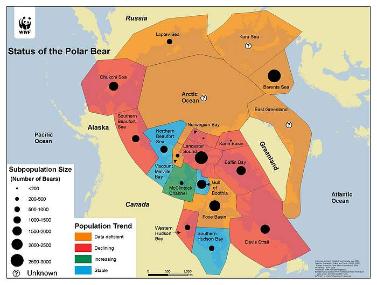
“Reviewing the latest information available the PBSG concluded that 1 of 19
subpopulations is currently increasing, 3 are stable and 8 are declining. For the
remaining 7 subpopulations available data were insufficient to provide an assessment
of current trend. The total number of polar bears is still thought to be between 20,000
and 25,000” – Map shows Locations of polar bear populations around the Arctic as of
July, 2009.
© WWF .
02: http://spacescience.spaceref.com/newhome/headlines/essd5feb97_1.htm
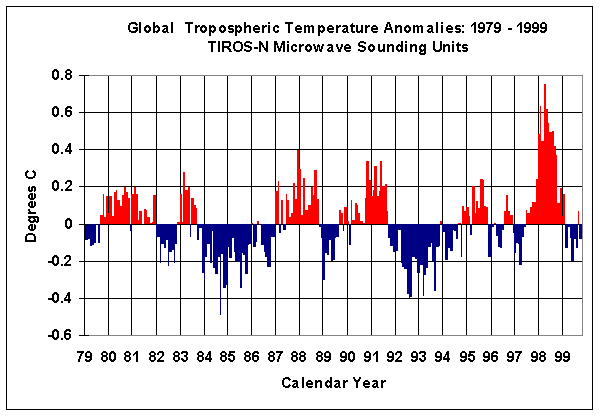
Dr. Roy Spencer, a scientist at NASA/Marshall and principal author on the paper, has
been monitoring the temperature of layers in the Earth's atmosphere from space.
Along with Dr. John Christy of the University of Alabama in Huntsville, Spencer has
produced a temperature record spanning 18 years. Acquired from Microwave
Sounding Unit (MSU) instruments flying aboard the TIROS series of weather satellites.
Their data show temperature variations in the lower troposphere, a region from the
surface to about 5 miles into the atmosphere.
"The temperatures we measure from space are actually on a very slight downward
trend since 1979 in the lower troposphere. We see major excursions due to volcanic
eruptions like Pinatubo, and ocean current phenomena like El Nino, but overall the
trend is about 0.05 degrees Celsius per decade cooling," Spencer remarked.
However, temperature measurements on land and ocean are up. "Thermometers
taking the temperature at the surface show a warming trend of about +0.10 to +0.15
degrees Celsius per decade," Spencer continued. "Current computer models of global
warming always predict that the temperature variations at the surface should increase
smoothly with height as you go up through the lowest 8 miles of the atmosphere." This
should make the temperature trend in the troposphere not only upward, but more
pronounced than on the surface.
But the space-based measurements show a more complex vertical structure, with
cooling in the lower portion of this deep layer and warming in the upper portion.
Spencer and co-author Dr. William Braswell of Nichols Research Corporation have
great confidence in the quality of their satellite data. "We've concluded there isn't a
problem with the measurements," Spencer explained. "In fact, balloon measurements of
the temperature in the same regions of the atmosphere we measure from space are in
excellent agreement with the satellite results."
"Instead, we believe the problem resides in the computer models and in our past
assumptions that the atmosphere is so well behaved. These models just don't handle
processes like clouds, water vapor, and precipitation systems well enough to
accurately predict how strong global warming will be, or how it will manifest itself at
different heights in the atmosphere," remarked Spencer.
03:
http://www.globalwarmingart.com/wiki/Wikipedia:
Temperature_record_of_the_past_1000_years
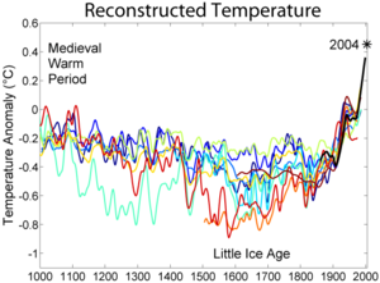
According to all major temperature reconstructions published in peer-reviewed journals
(see graph), the increase in temperature in the 20th century and the temperature in
the late 20th century is the highest in the record. Attention has tended to focus on the
early work of Michael E. Mann, Bradley and Hughes (1998), whose "hockey stick"
graph was featured in the 2001 United Nations Intergovernmental Panel on Climate
Change report. The methodology and data sets used in creating the Mann et al.
(1998) version of the hockey stick graph are disputed, most notably by Stephen
McIntyre and Ross McKitrick.
04:
http://www.globalwarmingart.com/wiki/Wikipedia:Attribution_of_recent_climate_change
Attribution of recent climate change is the effort to scientifically ascertain mechanisms
responsible for relatively recent changes observed in the Earth's climate. The effort
has focused on changes observed during the period of instrumental temperature
record, when records are most reliable; particularly on the last 50 years, when human
activity has grown fastest and observations of the upper atmosphere have become
available. The dominant mechanisms to which recent climate change has been
attributed all result from human activity. They are:[1]
increasing atmospheric concentrations of greenhouse gases
global changes to land surface, such as deforestation
increasing atmospheric concentrations of aerosols.
Recent reports from the Intergovernmental Panel on Climate Change (IPCC) have
concluded that:
"Most of the observed increase in globally averaged temperatures since the mid-20th
century is very likely due to the observed increase in anthropogenic greenhouse gas
concentrations."[2]
"From new estimates of the combined anthropogenic forcing due to greenhouse gases,
aerosols, and land surface changes, it is extremely likely that human activities have
exerted a substantial net warming influence on climate since 1750."[1]
"It is virtually certain that anthropogenic aerosols produce a net negative radiative
forcing (cooling influence) with a greater magnitude in the Northern Hemisphere than in
the Southern Hemisphere.[1]
The panel, which represents consensus in the scientific community, defines "very
likely," "extremely likely," and "virtually certain" as indicating probabilities greater than
90%, 95%, and 99%, respectively.[1]
----
http://www.globalwarmingart.com/wiki/Wikipedia:Attribution_of_recent_climate_change
Over the past 150 years human activities have released increasing quantities of
greenhouse gases into the atmosphere. This has led to increases in mean global
temperature, or global warming. Other human effects are relevant—for example,
sulphate aerosols are believed to lead to cooling—and natural factors also contribute.
According to the historical temperature record of the last century, the Earth's near-
surface air temperature has risen around 0.74 ± 0.18 °Celsius (1.3 ± 0.32 °Fahrenheit).
A historically important question in climate change research has regarded the relative
importance of human activity and non-anthropogenic causes during the period of
instrumental record. In the 1995 Second Assessment Report (SAR), the IPCC made
the widely-quoted statement that "The balance of evidence suggests a discernible
human influence on global climate". The phrase "balance of evidence" suggested the
(English) common-law standard of proof required in civil as opposed to criminal courts:
not as high as "beyond reasonable doubt". In 2001 the Third Assessment Report
(TAR) refined this, saying "There is new and stronger evidence that most of the
warming observed over the last 50 years is attributable to human activities".[9] The
2007 fourth assessment report (WG1 AR4) strengthened this finding:
05:
http://www.guardian.co.uk/environment/2009/nov/23/climate-sceptics-bob-ward-nigel-
lawson
Climate change champion and sceptic both call for inquiry into leaked emailsBoth sides
of climate change debate urge investigation as Met Office dismisses 'shallow attempt to
discredit robust science'
Leo Hickman guardian.co.uk, Monday 23 November 2009 16.23 GMT
Prominent voices on both sides of the climate change debate today called for an
independent inquiry into claims of collusion between climate scientists after it emerged
last week that hundreds of their emails and documents had been leaked that allegedly
manipulated data and destroyed evidence for Freedom of Information Act requests.
Writing in the Times, Lord Lawson, the former Conservative chancellor and long-time
climate change sceptic, said: "The integrity of the scientific evidence on which not
merely the British government, but other countries, too, through the Intergovernmental
Panel on Climate Change, claim to base far-reaching and hugely expensive policy
decisions, has been called into question. And the reputation of British science has
been seriously tarnished. A high-level independent inquiry must be set up without
delay."
Bob Ward, director of policy and communications at the Grantham Research Institute
on Climate Change and the Environment at the London School of Economics, said:
"Once appropriate action has been taken over the hacking, there has to be some
process to assess the substance of the email messages as well. The selective
disclosure and dissemination of the messages has created the impression of
impropriety, and the only way of clearing the air now would be through a rigorous
investigation. I have sympathy for the climate researchers at the University of East
Anglia and other institutions who have been the target of an aggressive campaign by
so-called 'sceptics' over a number of years. But I fear that only a thorough investigation
could now clear their names."
He added: "There needs to be an assurance that these email messages have not
revealed inappropriate conduct in the preparation of journal articles and in dealing with
requests from other researchers for access to data. This will probably require
investigations both by the host institutions and by the relevant journals. There may
also be a role for the UK Research Integrity Office to advise on any investigation."
A spokesperson for Nature, the science journal mentioned by name in one of the
alleged emails that sceptics say provides evidence of data manipulation and collusion,
declined to comment.
A spokesperson for the UK Research Integrity Office said it wouldn't comment on this
case, but added: "UKRIO is not a regulatory body and does not have a case
investigation role, though we can and do participate in investigations at the request of
an employer, regulator or other appropriate body or person. If a field of research is not
governed by statute, it normally devolves to the employer or grant funding body to
investigate."
The Met Office confirmed that none of its own computers has come under attack from
hackers and said that it would not call for an inquiry.
A spokesman at the Met Office, which jointly produces global temperature datasets with
the Climate Research Unit, said there was no need for an inquiry. "If you look at the
emails, there isn't any evidence that the data was falsified and there's no evidence that
climate change is a hoax. It's a shame that some of the sceptics have had to take this
rather shallow attempt to discredit robust science undertaken by some of the world's
most respected scientists. The bottom line is that temperatures continue to rise and
humans are responsible for it. We have every confidence in the science and the
various datasets we use. The peer-review process is as robust as it could possibly be.
It's no surprise, with the Copenhagen talks just days away, that this has happened
now."
Andy Atkins, Friends of the Earth's executive director, also dismissed calls for an
inquiry. He said: "Calls for an inquiry look suspiciously like an attempt to cast doubt on
the science of climate change ahead of crucial UN negotiations. The overwhelming
majority of climate scientists believe that climate change is happening, that it is man-
made, and that it poses a major threat to people across the planet. We can't afford to
be distracted from the need for urgent action to combat global warming – rich countries
must lead the way by agreeing to slash their emissions when they meet in Copenhagen
next month."
06:
http://www.guardian.co.uk/environment/2009/nov/20/climate-sceptics-hackers-leaked-
emails
Climate sceptics claim leaked emails are evidence of collusion among
scientistsHundreds of emails and documents exchanged between world's leading
climate scientists stolen by hackers and leaked online
Leo Hickman and James Randerson guardian.co.uk, Friday 20 November 2009 18.15
GMT
Hundreds of private emails and documents allegedly exchanged between some of the
world's leading climate scientists during the past 13 years have been stolen by hackers
and leaked online, it emerged today.
The computer files were apparently accessed earlier this week from servers at the
University of East Anglia's Climate Research Unit, a world-renowned centre focused on
the study of natural and anthropogenic climate change.
Climate change sceptics who have studied the emails allege they provide "smoking
gun" evidence that some of the climatologists colluded in manipulating data to support
the widely held view that climate change is real, and is being largely caused by the
actions of mankind.
The veracity of the emails has not been confirmed and the scientists involved have
declined to comment on the story, which broke on a blog called The Air Vent.
The files, which in total amount to 160MbB of data, were first uploaded on to a Russian
server, before being widely mirrored across the internet. The emails were accompanied
by the anonymous statement: "We feel that climate science is, in the current situation,
too important to be kept under wraps. We hereby release a random selection of
correspondence, code and documents. Hopefully it will give some insight into the
science and the people behind it."
A spokesperson for the University of East Anglia said: "We are aware that information
from a server used for research information in one area of the university has been
made available on public websites. Because of the volume of this information we
cannot currently confirm that all this material is genuine. This information has been
obtained and published without our permission and we took immediate action to
remove the server in question from operation. We are undertaking a thorough internal
investigation and have involved the police in this inquiry."
In one email, dated November 1999, one scientist wrote: "I've just completed Mike's
Nature [the science journal] trick of adding in the real temps to each series for the last
20 years (ie, from 1981 onwards) and from 1961 for Keith's to hide the decline."
This sentence, in particular, has been leapt upon by sceptics as evidence of
manipulating data, but the credibility of the email has not been verified. The scientists
who allegedly sent it declined to comment on the email.
"It does look incriminating on the surface, but there are lots of single sentences that
taken out of context can appear incriminating," said Bob Ward, director of policy and
communications at the Grantham Research Institute on Climate Change and the
Environment at the London School of Economics. "You can't tell what they are talking
about. Scientists say 'trick' not just to mean deception. They mean it as a clever way of
doing something - a short cut can be a trick."
In another alleged email, one of the scientists apparently refers to the death of a
prominent climate change sceptic by saying "in an odd way this is cheering news".
Ward said that if the emails are correct, they "might highlight behaviour that those
individuals might not like to have made public." But he added, "Let's separate out [the
climate scientists] reacting badly to the personal attacks [from sceptics] to the idea that
their work has been carried out in an inappropriate way."
The revelations did not alter the huge body of evidence from a variety of scientific
fields that supports the conclusion that modern climate change is caused largely by
human activity, Ward said. The emails refer largely to work on so-called paleoclimate
data - reconstructing past climate scenarios using data such as ice cores and tree
rings. "Climate change is based on several lines of evidence, not just paleoclimate
data," he said. "At the heart of this is basic physics."
Ward pointed out that the individuals named in the alleged emails had numerous
publications in peer-reviewed scientific journals. "It would be very surprising if after all
this time, suddenly they were found out doing something as wrong as that."
Professor Michael Mann, director of Pennsylvania State University's Earth System
Science Centre and a regular contributor to the popular climate science blog Real
Climate, features in many of the email exchanges. He said: "I'm not going to comment
on the content of illegally obtained emails. However, I will say this: both their theft and, I
believe, any reproduction of the emails that were obtained on public websites, etc,
constitutes serious criminal activity. I'm hoping the perpetrators and their facilitators will
be tracked down and prosecuted to the fullest extent the law allows."
When the Guardian asked Prof Phil Jones at UEA, who features in the
correspondence, to verify whether the emails were genuine, he refused to comment.
The alleged emails illustrate the persistent pressure some climatologists have been
under from sceptics in recent years. There have been repeated calls, including
Freedom of Information requests, for the Climate Research Unit to make public a
confidential dataset of land and sea temperature recordings that is "value added" by
the unit before being used by the Met Office. The emails show the frustration some
climatologists have had at having to operate under such intense, often politically
motivated, scrutiny.
Prof Bob Watson, the chief scientific advisor at the Department for the Environment,
Food and Rural Affairs said, "Evidence for climate change is irrefutable. The world's
leading scientists overwhelmingly agree what we're experiencing is not down to natural
variation."
"With this overwhelming scientific body of evidence failing to take action to tackle
climate change would be the wrong thing to do – the impacts here in Britain and across
the world will worsen and the economic consequences will be catastrophic."
A spokesman for Greenpeace said: "If you looked through any organisation's emails
from the last 10 years you'd find something that would raise a few eyebrows. Contrary
to what the sceptics claim, the Royal Society, the US National Academy of Sciences,
Nasa and the world's leading atmospheric scientists are not the agents of a clandestine
global movement against the truth. This stuff might drive some web traffic, but so does
David Icke."
==============================
Other links:
Climate Change Could Spread Plague: Scientists
Posted on: Monday, 14 November 2005, 06:20 CST
http://www.redorbit.
com/news/science/304241/climate_change_could_spread_plague_scientists/index.html
Determining The Human Health Risks From Climate Change
Posted on: Thursday, 28 May 2009, 15:35 CDT
http://www.redorbit.
com/news/health/1696439/determining_the_human_health_risks_from_climate_change/index.html
========================
Colin Andrews own statement – Man-made or not: action is required regardless:
com/news/science/1789881/staggering_global_warming_statistics_emerge_as_un_meeting_looms/
Staggering Global Warming Statistics Emerge As UN Meeting Looms
Posted on: Monday, 23 November 2009, 06:20 CST
Since the 1997 international agreement to address global warming, climate change has
seen its ups and downs, including extremely bleak warnings.
So far, the world’s oceans have raised an inch and a half, serious droughts have
plagued parts of the world, temperatures everywhere are warmer, and several
endangered species continue to be threatened.
"The latest science is telling us we are in more trouble than we thought," said Janos
Pasztor, climate adviser to UN Secretary General Ban Ki-moon, to AP News.
It is suspected that since the original agreement signed in Kyoto, Japan, in December
1997, is that the amount of carbon dioxide in the air has grown 6.5%. Officials will meet
in Copenhagen next month to seek create a new pact, which President Barack Obama
says "has immediate operational effect ... an important step forward in the effort to rally
the world around a solution."
From 1997 to 2008, world carbon dioxide has leapt up 31%. Emissions from China
have doubled since 1997.
"Back in 1997, the impacts (of climate change) were underestimated; the rate of
change has been faster," noted Virginia Burkett, leading scientist for global change
research at the U.S. Geological Survey. This scares former Vice President Al Gore,
who helped create a last-minute pact in Kyoto.
"By far the most serious differences that we've had is an acceleration of the crisis
itself," Gore said to The Associated Press.
Since 1997, the issue of global warming has spread to all facets of business.
"We've come from a time in 1997 where this was some abstract problem working its
way around scientific circles to now when the problem is in everyone's face," said
Andrew Weaver, a University of Victoria climate scientist.
The issue that has scientists most afraid deals with the Arctic and melting summer sea
ice. Back in 1997 "nobody in their wildest expectations," would have contemplated a
loss of summer sea ice, Weaver said.
Globally, glaciers are disintegrating three times rapider than in the 1970s and the
normal glacier has melted 25 feet since 1997, mentioned Michael Zemp, scientist at
World Glacier Monitoring Service at the University of Zurich.
"Glaciers are a good climate indicator," Zemp said. "What we see is an accelerated
loss of ice."
Oceans are also growing more acidic due to carbon dioxide in the air that is being
drawn into the water. Acidic water is hazardous to coral, oysters and plankton and will
harm the ocean food chain, biologists note.
"The message on the science is that we know a lot more than we did in 1997 and it's all
negative," said Eileen Claussen, head of the Pew Center on Global Climate Change.
"Things are much worse than the models predicted."
Source: RedOrbit Staff & Wire Reports
====================
http://www.chron.com/disp/story.mpl/editorial/6734481.html
Hot times
As a crucial climate change conference nears, more evidence of a
warming globe
HOUSTON CHRONICLE
Nov. 22, 2009, 9:29PM
As world governments prepare for a pivotal conference in Copenhagen next month to
map future strategy to contain global warming, and the U.S. Congress debates
legislation to reduce carbon emissions, evidence continues to accumulate that the
threat is accelerating.
A new study by a team of British scientists indicates that man-made carbon emissions
continue to increase despite the global recession. While emissions in the United States
fell by 3 percent last year, they jumped 2 percent worldwide, most of the increase
coming from China. The U.S. and China are the world's largest carbon emitters.
Equally ominous, the planet's oceans are steadily losing capacity to absorb the
greenhouse gases that trap heat and fuel global warming.
The Global Carbon Project study concludes that unless emissions are substantially
reduced, the result would be a rise in average global temperature by nearly 10
degrees Fahrenheit by the end of the century. That is on par with previous worst-case
scenarios outlined by the United Nations Intergovernmental Panel on Climate Change.
Scientists have estimated that temperature spikes above 2 degrees could have
disastrous consequences, including large rises in sea level, droughts and stronger
storms.
One of the authors of the study, Professor Corinne Le Quere of the University of East
Anglia, says the conclusions raise the stakes for delegates to the Copenhagen
gathering, who will try to hammer out a successor to the Kyoto Accords that committed
signatory governments to emission reduction goals. The United States did not sign on
to that agreement.
In another indication that global warming is accelerating, record minimum sea ice in the
Arctic was reported last month. The Catlin Arctic Survey estimates that based on the
dwindling expanse and thickness of ice coverage, the Arctic Ocean will become ice free
in summer within two decades.
The latest developments should raise the political heat in Washington to produce
workable legislation to reduce carbon emissions while propelling the U.S. into a
leadership role in crafting an international agreement to limit climate change.
====================
Call For Independent Inquiry Into Climategate as Global Warming Fraud Implodes
http://www.prisonplanet.com/call-for-independent-inquiry-into-climategate-as-global-
warming-fraud-implodes.html
Paul Joseph Watson
Prison Planet.com
Monday, November 23, 2009
Calls for an independent inquiry into what is being dubbed “Climategate” are growing
as the foundation for man-made global warming implodes following the release of
emails which prove researchers colluded to manipulate data in order to “hide the
decline” in global temperatures.
Former British chancellor Lord Lawson was the latest to demand an impartial
investigation be launched into the scandal, which arrives just weeks before the UN
climate conference in Copenhagen. “They should set up a public inquiry under
someone who is totally respected and get to the truth,” he told the BBC Radio Four
Today programme.
The emails were leaked at the end of last week after hackers penetrated the servers of
the Climatic Research Unit, which is based at the University of East Anglia, in eastern
England. The CRU is described as one of the leading climate research bodies in the
world.
The hacked documents and communications reveal how top scientists conspired to
falsify data in the face of declining global temperatures in order to prop up the premise
that man-made factors are driving climate change. Others illustrate how they embarked
on a venomous and coordinated campaign to ostracize climate skeptics and use their
influence to keep dissenting reports from appearing in peer-reviewed journals, as well
as using cronyism to avoid compliance with Freedom of Information Act requests.
As expected, the establishment media has gone into whitewash overdrive,
characterizing the emails as evidence of “rancor” amongst the climate community and
focusing on some of the lesser emails while ignoring the true significance of what has
been revealed.
Organizations with close ties to the CRU have engaged in psychological terrorism by
fearmongering about the planet with doomsday scenarios, illustrating their argument
with outlandish propaganda animation videos which show pets drowning and others
that show computer-generated polar bears (Note 01) crashing to earth in a throwback
to 9/11 victims jumping from the towers, when in reality polar bear population figures
are thriving.
“One of the emails under scrutiny, written by Phil Jones, the centre’s director, in 1999,
reads: “I’ve just completed Mike’s Nature [the science journal] trick of adding in the real
temps to each series for the last 20 years (ie, from 1981 onwards) and from 1961 for
Keith’s to hide the decline,” reports the London Telegraph.
The author admitted to the Associated Press that the e mail was genuine.
In another example, researchers discuss data that is “artificially adjusted to look closer
to the real temperatures”. Apparently, the “real temperatures” are whatever global
warming cheerleaders want them to be.
As Anthony Watts writes, attempts to claim e mails are “out of context,” as the defense
has been from CRU, cannot apply in this instance.
You can claim an email you wrote years ago isn’t accurate saying it was “taken out of
context”, but a programmer making notes in the code does so that he/she can
document what the code is actually doing at that stage, so that anyone who looks at it
later can figure out why this function doesn’t plot past 1960. In this case, it is not
allowing all of the temperature data to be plotted. Growing season data (summer
months when the new tree rings are formed) past 1960 is thrown out because “these
will be artificially adjusted to look closer to the real temperatures”, which implies some
post processing routine.
Spin that, spin it to the moon if you want. I’ll believe programmer notes over the word of
somebody who stands to gain from suggesting there’s nothing “untowards” about it.
Either the data tells the story of nature or it does not. Data that has been “artificially
adjusted to look closer to the real temperatures” is false data, yielding a false result.
Another email discusses changing temperature data to fix “blips” in studies so as to
make them conform with expectations, which of course is the cardinal sin of scientific
research.
“Conspiracy, collusion in exaggerating warming data, possibly illegal destruction of
embarrassing information, organized resistance to disclosure, manipulation of data,
private admissions of flaws in their public claims and much more” was revealed in the
61 megabites of confidential files released on the Internet for anyone to read, writes
Andrew Bolt.
Another email appears to celebrate the death of climate change skeptic John L Daly,
with the words, “In an odd way this is cheering news.”
In another communication, the author expresses his fantasy to “beat the crap out of”
climate change skeptics.
In another exchange, researchers appear to discuss ways to discredit James Saiers of
the Geophysical Research Letters journal, by means of an academic witch hunt,
because of his sympathies with climate change skeptics.
“If you think that Saiers is in the greenhouse skeptics camp, then, if we can find
documentary evidence of this, we could go through official AGU channels to get him
ousted.”
Other emails express doubt about whether the world is really heating up and infer that
data needs to be reinterpreted.
“The fact is that we can’t account for the lack of warming at the moment and it is a
travesty that we can’t. The CERES data published in the August BAMS 09 supplement
on 2008 shows there should be even more warming: but the data are surely wrong.
Our observing system is inadequate.”
Scientists discuss trying to disguise historical data that contradicts the man-made
climate change thesis, such as the Medieval Warm Period (MWP), which must be
‘contained’ according to one email.
Suppression of evidence is also discussed, with scientists resolving to delete
embarrassing emails.
“And, perhaps most reprehensibly,” writes James Delingpole, a long series of
communications discussing how best to squeeze dissenting scientists out of the peer
review process. How, in other words, to create a scientific climate in which anyone who
disagrees with AGW can be written off as a crank, whose views do not have a scrap of
authority.”
“This was the danger of always criticising the skeptics for not publishing in the “peer-
reviewed literature”. Obviously, they found a solution to that–take over a journal! So
what do we do about this? I think we have to stop considering “Climate Research” as a
legitimate peer-reviewed journal. Perhaps we should encourage our colleagues in the
climate research community to no longer submit to, or cite papers in, this journal. We
would also need to consider what we tell or request of our more reasonable colleagues
who currently sit on the editorial board…What do others think?”
“I will be emailing the journal to tell them I’m having nothing more to do with it until they
rid themselves of this troublesome editor.”“It results from this journal having a number
of editors. The responsible one for this is a well-known skeptic in NZ. He has let a few
papers through by Michaels and Gray in the past. I’ve had words with Hans von Storch
about this, but got nowhere. Another thing to discuss in Nice!”
Scientists also “discussed ways of dodging Freedom of Information Act requests to
release temperature data,” reports the Daily Mail.
The emails show that scientists relied on cronyism and cosying up to FOIA officials to
prevent them from being forced to release data.
“When the FOI requests began here, the FOI person said we had to abide by the
requests,’ the email says. “It took a couple of half-hour sessions to convince them
otherwise.”
“Once they became aware of the types of people we were dealing with, everyone at
UEA became very supportive. I’ve got to know the FOI person quite well and the chief
librarian – who deals with appeals.”
It is important to stress that this compendium merely scratches the surface of the
monumental levels of fraud that have been exposed as a result of the hacked emails.
People will look back on this moment as the beginning of the end for global warming
alarmism and the agenda to implement draconian measures of regulation and control
along with the levy of a global carbon tax.
Many more revelations will be forthcoming as a result of this leak, and the desperate
effort on behalf of the establishment to whitewash the whole issue will only end up
making the damage worse (Note 02 and 03).
http://www.examiner.com/x-4383-Portland-Progressive-Examiner~y2009m11d22-
Climate-change-skeptics-use-hacked-emails-as-propaganda
Climate change skeptics use hacked emails as propaganda
November 22, 5:35 PMPortland Progressive ExaminerMichael Stone
Climate change skeptics are using hacked emails as propaganda in their campaign to
suppress and deny knowledge of anthropogenic climate change. The emails were
stolen from a climate research institute in Great Britain. The utilization of hacked emails
is just the latest ploy of right wing nuts and other outliers who refuse the reality of
anthropogenic (human caused) climate change.
The emails were hacked from the Climate Research Unit at the University of East
Anglia. It is one of the United Kingdom’s leading climate research centers and has
been a strong proponent of the position that global warming is real and has human
causes.
More than 169 megabytes worth of global-warming emails and related files were
hacked. Climate change deniers are at this very moment pouring through the data,
pulling quotes and numbers out of context and cherry picking facts and statements in
order to make their case against climate change, a case that stands not on science,
but on propaganda and denial.
Most U.S. politicians, most citizens, do not question whether humans are changing the
world's climate. It is simply accepted as a truth, a truth that is at once both intuitive and
unavoidable given the activity of humanity in the last 500 years.
It is sad, and a curious fact of human nature, that a minority of humans, given the
opportunity, wind up wearing the proverbial "tin foil hat", and deny what science gives
as fact. Public debate will persist. The theft of the emails will simply fuel the delusions
and confusions, and perhaps even postpone action that is required now in order to
minimize the damage we are doing to our planet.
===============
Colin Andrews research notes:
01: http://www.panda.
org/what_we_do/where_we_work/arctic/area/species/polarbear/population/
In 2005, the IUCN Polar Bear Specialist Group (PBSG) reviewed the status of polar
bears using the IUCN Red List categories and criteria.
The group concluded that the Red List classification of the polar bear should be
upgraded from Least Concern to Vulnerable based on the likelihood of a decline in the
total global polar bear population of more than 30% within the next 35 to 50 years.
The US Government has classified the Polar Bear under its Endangered Species Act
(ESA).
The main cause of this projected decline in polar bear numbers is climatic warming and
its consequent negative effects on the sea ice habitat of polar bears.
This agreement on the status of polar bears regulates hunting and habitat protection,
but it does not protect bears against the biggest man-made threat to their survival:
global warming.
If current warming trends continue unabated, scientists believe that polar bears will be
vulnerable to extinction within the next century.
“Reviewing the latest information available the PBSG concluded that 1 of 19
subpopulations is currently increasing, 3 are stable and 8 are declining. For the
remaining 7 subpopulations available data were insufficient to provide an assessment
of current trend. The total number of polar bears is still thought to be between 20,000
and 25,000” – Map shows Locations of polar bear populations around the Arctic as of
July, 2009.
© WWF .
02: http://spacescience.spaceref.com/newhome/headlines/essd5feb97_1.htm
Dr. Roy Spencer, a scientist at NASA/Marshall and principal author on the paper, has
been monitoring the temperature of layers in the Earth's atmosphere from space.
Along with Dr. John Christy of the University of Alabama in Huntsville, Spencer has
produced a temperature record spanning 18 years. Acquired from Microwave
Sounding Unit (MSU) instruments flying aboard the TIROS series of weather satellites.
Their data show temperature variations in the lower troposphere, a region from the
surface to about 5 miles into the atmosphere.
"The temperatures we measure from space are actually on a very slight downward
trend since 1979 in the lower troposphere. We see major excursions due to volcanic
eruptions like Pinatubo, and ocean current phenomena like El Nino, but overall the
trend is about 0.05 degrees Celsius per decade cooling," Spencer remarked.
However, temperature measurements on land and ocean are up. "Thermometers
taking the temperature at the surface show a warming trend of about +0.10 to +0.15
degrees Celsius per decade," Spencer continued. "Current computer models of global
warming always predict that the temperature variations at the surface should increase
smoothly with height as you go up through the lowest 8 miles of the atmosphere." This
should make the temperature trend in the troposphere not only upward, but more
pronounced than on the surface.
But the space-based measurements show a more complex vertical structure, with
cooling in the lower portion of this deep layer and warming in the upper portion.
Spencer and co-author Dr. William Braswell of Nichols Research Corporation have
great confidence in the quality of their satellite data. "We've concluded there isn't a
problem with the measurements," Spencer explained. "In fact, balloon measurements of
the temperature in the same regions of the atmosphere we measure from space are in
excellent agreement with the satellite results."
"Instead, we believe the problem resides in the computer models and in our past
assumptions that the atmosphere is so well behaved. These models just don't handle
processes like clouds, water vapor, and precipitation systems well enough to
accurately predict how strong global warming will be, or how it will manifest itself at
different heights in the atmosphere," remarked Spencer.
03:
http://www.globalwarmingart.com/wiki/Wikipedia:
Temperature_record_of_the_past_1000_years
According to all major temperature reconstructions published in peer-reviewed journals
(see graph), the increase in temperature in the 20th century and the temperature in
the late 20th century is the highest in the record. Attention has tended to focus on the
early work of Michael E. Mann, Bradley and Hughes (1998), whose "hockey stick"
graph was featured in the 2001 United Nations Intergovernmental Panel on Climate
Change report. The methodology and data sets used in creating the Mann et al.
(1998) version of the hockey stick graph are disputed, most notably by Stephen
McIntyre and Ross McKitrick.
04:
http://www.globalwarmingart.com/wiki/Wikipedia:Attribution_of_recent_climate_change
Attribution of recent climate change is the effort to scientifically ascertain mechanisms
responsible for relatively recent changes observed in the Earth's climate. The effort
has focused on changes observed during the period of instrumental temperature
record, when records are most reliable; particularly on the last 50 years, when human
activity has grown fastest and observations of the upper atmosphere have become
available. The dominant mechanisms to which recent climate change has been
attributed all result from human activity. They are:[1]
increasing atmospheric concentrations of greenhouse gases
global changes to land surface, such as deforestation
increasing atmospheric concentrations of aerosols.
Recent reports from the Intergovernmental Panel on Climate Change (IPCC) have
concluded that:
"Most of the observed increase in globally averaged temperatures since the mid-20th
century is very likely due to the observed increase in anthropogenic greenhouse gas
concentrations."[2]
"From new estimates of the combined anthropogenic forcing due to greenhouse gases,
aerosols, and land surface changes, it is extremely likely that human activities have
exerted a substantial net warming influence on climate since 1750."[1]
"It is virtually certain that anthropogenic aerosols produce a net negative radiative
forcing (cooling influence) with a greater magnitude in the Northern Hemisphere than in
the Southern Hemisphere.[1]
The panel, which represents consensus in the scientific community, defines "very
likely," "extremely likely," and "virtually certain" as indicating probabilities greater than
90%, 95%, and 99%, respectively.[1]
----
http://www.globalwarmingart.com/wiki/Wikipedia:Attribution_of_recent_climate_change
Over the past 150 years human activities have released increasing quantities of
greenhouse gases into the atmosphere. This has led to increases in mean global
temperature, or global warming. Other human effects are relevant—for example,
sulphate aerosols are believed to lead to cooling—and natural factors also contribute.
According to the historical temperature record of the last century, the Earth's near-
surface air temperature has risen around 0.74 ± 0.18 °Celsius (1.3 ± 0.32 °Fahrenheit).
A historically important question in climate change research has regarded the relative
importance of human activity and non-anthropogenic causes during the period of
instrumental record. In the 1995 Second Assessment Report (SAR), the IPCC made
the widely-quoted statement that "The balance of evidence suggests a discernible
human influence on global climate". The phrase "balance of evidence" suggested the
(English) common-law standard of proof required in civil as opposed to criminal courts:
not as high as "beyond reasonable doubt". In 2001 the Third Assessment Report
(TAR) refined this, saying "There is new and stronger evidence that most of the
warming observed over the last 50 years is attributable to human activities".[9] The
2007 fourth assessment report (WG1 AR4) strengthened this finding:
05:
http://www.guardian.co.uk/environment/2009/nov/23/climate-sceptics-bob-ward-nigel-
lawson
Climate change champion and sceptic both call for inquiry into leaked emailsBoth sides
of climate change debate urge investigation as Met Office dismisses 'shallow attempt to
discredit robust science'
Leo Hickman guardian.co.uk, Monday 23 November 2009 16.23 GMT
Prominent voices on both sides of the climate change debate today called for an
independent inquiry into claims of collusion between climate scientists after it emerged
last week that hundreds of their emails and documents had been leaked that allegedly
manipulated data and destroyed evidence for Freedom of Information Act requests.
Writing in the Times, Lord Lawson, the former Conservative chancellor and long-time
climate change sceptic, said: "The integrity of the scientific evidence on which not
merely the British government, but other countries, too, through the Intergovernmental
Panel on Climate Change, claim to base far-reaching and hugely expensive policy
decisions, has been called into question. And the reputation of British science has
been seriously tarnished. A high-level independent inquiry must be set up without
delay."
Bob Ward, director of policy and communications at the Grantham Research Institute
on Climate Change and the Environment at the London School of Economics, said:
"Once appropriate action has been taken over the hacking, there has to be some
process to assess the substance of the email messages as well. The selective
disclosure and dissemination of the messages has created the impression of
impropriety, and the only way of clearing the air now would be through a rigorous
investigation. I have sympathy for the climate researchers at the University of East
Anglia and other institutions who have been the target of an aggressive campaign by
so-called 'sceptics' over a number of years. But I fear that only a thorough investigation
could now clear their names."
He added: "There needs to be an assurance that these email messages have not
revealed inappropriate conduct in the preparation of journal articles and in dealing with
requests from other researchers for access to data. This will probably require
investigations both by the host institutions and by the relevant journals. There may
also be a role for the UK Research Integrity Office to advise on any investigation."
A spokesperson for Nature, the science journal mentioned by name in one of the
alleged emails that sceptics say provides evidence of data manipulation and collusion,
declined to comment.
A spokesperson for the UK Research Integrity Office said it wouldn't comment on this
case, but added: "UKRIO is not a regulatory body and does not have a case
investigation role, though we can and do participate in investigations at the request of
an employer, regulator or other appropriate body or person. If a field of research is not
governed by statute, it normally devolves to the employer or grant funding body to
investigate."
The Met Office confirmed that none of its own computers has come under attack from
hackers and said that it would not call for an inquiry.
A spokesman at the Met Office, which jointly produces global temperature datasets with
the Climate Research Unit, said there was no need for an inquiry. "If you look at the
emails, there isn't any evidence that the data was falsified and there's no evidence that
climate change is a hoax. It's a shame that some of the sceptics have had to take this
rather shallow attempt to discredit robust science undertaken by some of the world's
most respected scientists. The bottom line is that temperatures continue to rise and
humans are responsible for it. We have every confidence in the science and the
various datasets we use. The peer-review process is as robust as it could possibly be.
It's no surprise, with the Copenhagen talks just days away, that this has happened
now."
Andy Atkins, Friends of the Earth's executive director, also dismissed calls for an
inquiry. He said: "Calls for an inquiry look suspiciously like an attempt to cast doubt on
the science of climate change ahead of crucial UN negotiations. The overwhelming
majority of climate scientists believe that climate change is happening, that it is man-
made, and that it poses a major threat to people across the planet. We can't afford to
be distracted from the need for urgent action to combat global warming – rich countries
must lead the way by agreeing to slash their emissions when they meet in Copenhagen
next month."
06:
http://www.guardian.co.uk/environment/2009/nov/20/climate-sceptics-hackers-leaked-
emails
Climate sceptics claim leaked emails are evidence of collusion among
scientistsHundreds of emails and documents exchanged between world's leading
climate scientists stolen by hackers and leaked online
Leo Hickman and James Randerson guardian.co.uk, Friday 20 November 2009 18.15
GMT
Hundreds of private emails and documents allegedly exchanged between some of the
world's leading climate scientists during the past 13 years have been stolen by hackers
and leaked online, it emerged today.
The computer files were apparently accessed earlier this week from servers at the
University of East Anglia's Climate Research Unit, a world-renowned centre focused on
the study of natural and anthropogenic climate change.
Climate change sceptics who have studied the emails allege they provide "smoking
gun" evidence that some of the climatologists colluded in manipulating data to support
the widely held view that climate change is real, and is being largely caused by the
actions of mankind.
The veracity of the emails has not been confirmed and the scientists involved have
declined to comment on the story, which broke on a blog called The Air Vent.
The files, which in total amount to 160MbB of data, were first uploaded on to a Russian
server, before being widely mirrored across the internet. The emails were accompanied
by the anonymous statement: "We feel that climate science is, in the current situation,
too important to be kept under wraps. We hereby release a random selection of
correspondence, code and documents. Hopefully it will give some insight into the
science and the people behind it."
A spokesperson for the University of East Anglia said: "We are aware that information
from a server used for research information in one area of the university has been
made available on public websites. Because of the volume of this information we
cannot currently confirm that all this material is genuine. This information has been
obtained and published without our permission and we took immediate action to
remove the server in question from operation. We are undertaking a thorough internal
investigation and have involved the police in this inquiry."
In one email, dated November 1999, one scientist wrote: "I've just completed Mike's
Nature [the science journal] trick of adding in the real temps to each series for the last
20 years (ie, from 1981 onwards) and from 1961 for Keith's to hide the decline."
This sentence, in particular, has been leapt upon by sceptics as evidence of
manipulating data, but the credibility of the email has not been verified. The scientists
who allegedly sent it declined to comment on the email.
"It does look incriminating on the surface, but there are lots of single sentences that
taken out of context can appear incriminating," said Bob Ward, director of policy and
communications at the Grantham Research Institute on Climate Change and the
Environment at the London School of Economics. "You can't tell what they are talking
about. Scientists say 'trick' not just to mean deception. They mean it as a clever way of
doing something - a short cut can be a trick."
In another alleged email, one of the scientists apparently refers to the death of a
prominent climate change sceptic by saying "in an odd way this is cheering news".
Ward said that if the emails are correct, they "might highlight behaviour that those
individuals might not like to have made public." But he added, "Let's separate out [the
climate scientists] reacting badly to the personal attacks [from sceptics] to the idea that
their work has been carried out in an inappropriate way."
The revelations did not alter the huge body of evidence from a variety of scientific
fields that supports the conclusion that modern climate change is caused largely by
human activity, Ward said. The emails refer largely to work on so-called paleoclimate
data - reconstructing past climate scenarios using data such as ice cores and tree
rings. "Climate change is based on several lines of evidence, not just paleoclimate
data," he said. "At the heart of this is basic physics."
Ward pointed out that the individuals named in the alleged emails had numerous
publications in peer-reviewed scientific journals. "It would be very surprising if after all
this time, suddenly they were found out doing something as wrong as that."
Professor Michael Mann, director of Pennsylvania State University's Earth System
Science Centre and a regular contributor to the popular climate science blog Real
Climate, features in many of the email exchanges. He said: "I'm not going to comment
on the content of illegally obtained emails. However, I will say this: both their theft and, I
believe, any reproduction of the emails that were obtained on public websites, etc,
constitutes serious criminal activity. I'm hoping the perpetrators and their facilitators will
be tracked down and prosecuted to the fullest extent the law allows."
When the Guardian asked Prof Phil Jones at UEA, who features in the
correspondence, to verify whether the emails were genuine, he refused to comment.
The alleged emails illustrate the persistent pressure some climatologists have been
under from sceptics in recent years. There have been repeated calls, including
Freedom of Information requests, for the Climate Research Unit to make public a
confidential dataset of land and sea temperature recordings that is "value added" by
the unit before being used by the Met Office. The emails show the frustration some
climatologists have had at having to operate under such intense, often politically
motivated, scrutiny.
Prof Bob Watson, the chief scientific advisor at the Department for the Environment,
Food and Rural Affairs said, "Evidence for climate change is irrefutable. The world's
leading scientists overwhelmingly agree what we're experiencing is not down to natural
variation."
"With this overwhelming scientific body of evidence failing to take action to tackle
climate change would be the wrong thing to do – the impacts here in Britain and across
the world will worsen and the economic consequences will be catastrophic."
A spokesman for Greenpeace said: "If you looked through any organisation's emails
from the last 10 years you'd find something that would raise a few eyebrows. Contrary
to what the sceptics claim, the Royal Society, the US National Academy of Sciences,
Nasa and the world's leading atmospheric scientists are not the agents of a clandestine
global movement against the truth. This stuff might drive some web traffic, but so does
David Icke."
==============================
Other links:
Climate Change Could Spread Plague: Scientists
Posted on: Monday, 14 November 2005, 06:20 CST
http://www.redorbit.
com/news/science/304241/climate_change_could_spread_plague_scientists/index.html
Determining The Human Health Risks From Climate Change
Posted on: Thursday, 28 May 2009, 15:35 CDT
http://www.redorbit.
com/news/health/1696439/determining_the_human_health_risks_from_climate_change/index.html
========================
Colin Andrews own statement – Man-made or not: action is required regardless:
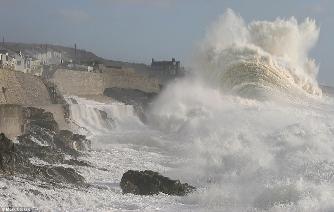
Huge waves off the south east coast of England during a storm which
brought the heaviest rainfall of 13 inches in 24 hours to part of the
country - The greatest rainfall on record. Copyright: Daily Mail
November 16, 2009.
brought the heaviest rainfall of 13 inches in 24 hours to part of the
country - The greatest rainfall on record. Copyright: Daily Mail
November 16, 2009.
| PAGE STILL UNDER CONSTRUCTION |

 |
 |
 |
 |
 |
 |
 |
 |
 |
 |
 |
 |